
Article by David Romeo · August 5, 2025
On August 29, 2025, the U.S. will officially eliminate the de minimis exemption that has allowed packages under $800 to enter duty-free. This loophole has been a critical pillar for cross-border e-commerce growth—especially for direct-to-consumer (DTC) brands shipping small parcels from Asia to American customers. Its removal signals one of the most significant structural changes to global e-commerce in over a decade.
What exactly is De Minimis?
The term “de minimis” comes from the Latin phrase “de minimis non curat lex”, meaning “the law does not concern itself with trifles.” In global trade, de minimis refers to a value threshold below which imported goods can enter a country without incurring duties or taxes.
In the U.S., that threshold has historically been $800, allowing e-commerce brands and marketplaces to ship low-value items directly to consumers without customs clearance or tariff costs. The de minimis rule was originally intended to reduce administrative burden for customs agencies—but has become a major enabler of cross-border direct-to-consumer shipping.
For digital-first brands operating outside the U.S., this isn’t just a trade policy shift. It’s a disruption to fulfillment strategies, landed cost models, pricing logic, and customer expectations. Whether you’re based in Canada, Europe, or Asia—if you sell into the U.S., your cross-border playbook needs urgent attention.
What’s Actually Changing?
Under the old de minimis rule, international packages under $800 could enter the U.S. without incurring tariffs. It allowed brands and marketplaces to ship directly to American doorsteps while avoiding most import taxes and customs duties. Starting August 29, that advantage disappears. Low-value parcels will now face flat-rate duties (ranging from $80 to $200) or ad-valorem tariffs based on the country of origin.
The only exceptions? Gifts under $100 and items personally brought into the country by travelers (up to $200).
For high-volume e-commerce sellers who built DTC models around low-margin, high-velocity shipments, this rule change is more than a financial inconvenience—it directly threatens their business model.
Real-World Disruption: What’s Happening with Shein and Temu
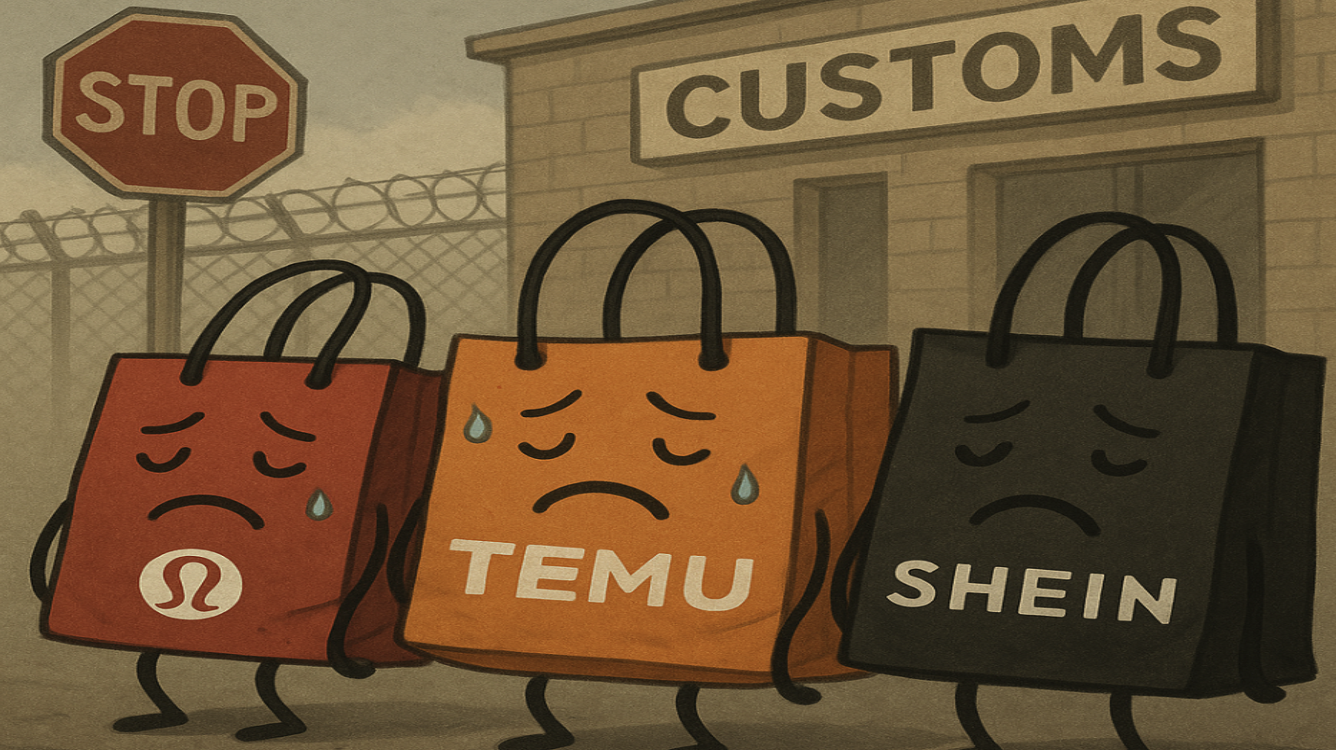
Two of the most prominent examples of this disruption are Shein and Temu, who have relied on the de minimis exemption to dominate the fast-fashion and budget shopping space. Their core model was built on the ability to ship millions of low-cost, individual items directly from overseas factories to U.S. customers, bypassing tariffs altogether.
Now, with each one of those packages subject to duties, the economics have changed dramatically. Both companies have already started raising prices for American shoppers to offset the impact. That means their biggest competitive edge—offering ultra-low prices with free or nearly-free shipping—has been materially weakened.
In response, both are restructuring their supply chains. Instead of shipping every order from overseas, they’ve begun bulk-importing goods to U.S. warehouses and fulfilling orders domestically. Temu was among the first to announce this shift, while Shein is reportedly expanding its manufacturing presence in Mexico, Turkey, and Brazil. This not only shortens delivery windows but also opens the door to more favorable trade terms.
In short, these giants are rapidly evolving into something closer to a hybrid retail model—with inventory, fulfillment, and pricing now much more sensitive to cross-border constraints.
Why USMCA Isn’t the Lifeline Some Think It Is
Canadian and Mexican brands may be tempted to assume that the USMCA agreement provides insulation from these changes. But the reality is more nuanced. For a product to qualify for tariff-free treatment under USMCA, it must originate in one of the three member countries. That’s a strict definition—and many e-commerce brands don’t meet it.
Take Lululemon as an example. While based in Vancouver and known globally as a Canadian success story, the company sources a significant portion of its products from Asia. In response to rising import costs, Lululemon has already begun implementing “modest and strategic” price increases for U.S. consumers in Q2 and Q3. Executives were clear: the changes are a direct result of tariffs on imports from China (30%) and other regions (10%).
If a brand with Lululemon’s scale and premium positioning is making pricing adjustments, the implications for mid-market or niche DTC sellers—especially those dependent on Asian sourcing—are even more urgent.
What This Means for E-Commerce Strategy
For cross-border sellers, this moment demands a strategic reset. Margins, delivery speed, and customer experience are all under pressure. Brands must now reexamine where they manufacture, how they move product, and how they calculate total landed cost during the checkout experience.
Relying on legacy fulfillment models—especially small-parcel international shipping from high-duty regions—is no longer viable without margin erosion or customer pushback. Brands that previously didn’t need to think much about customs documentation, HS codes, or duty optimization must now develop fluency in those areas.
This isn’t just a compliance problem. It’s a conversion problem, a cost problem, and a growth strategy problem.
How Leading E-Commerce Brands Are Adapting
As the de minimis exemption disappears, many global e-commerce brands are being forced to reevaluate long-held fulfillment and sourcing strategies. What was once a frictionless cross-border pipeline now involves increased tariff exposure, slower customs processing, and rising per-unit shipping costs.
In response, major players are rapidly adjusting. Temu and Shein, for instance, have already begun restructuring their supply chains. Rather than shipping millions of individual parcels directly to U.S. consumers from overseas factories, both companies are now importing goods in bulk to U.S.-based warehouses. This pivot allows them to manage duties more efficiently and reduce last-mile delivery times—at the cost of increased inventory risk and operational complexity.
Shein has also been reported to be diversifying its manufacturing base, expanding operations into countries like Turkey, Mexico, and Brazil in an effort to reduce dependency on China and to potentially benefit from more favorable trade agreements. These moves highlight a broader trend: global DTC brands are rethinking their sourcing geographies as well as their shipping lanes.
In parallel, other brands are:
- Implementing duties-paid (DDP) checkout experiences to maintain pricing transparency and avoid surprise charges at delivery
- Modeling margin impacts by product and region to inform assortment decisions and promotional pricing and potential duty subsidies
- Exploring Foreign Trade Zones (FTZs) or bonded warehouse setups to delay or defer duties until goods are sold or distributed
These shifts are not just tactical—they’re strategic. Brands that act early are better positioned to protect margins, preserve customer experience, and stay ahead of regulatory enforcement. Those who wait may find themselves grappling with sudden cost spikes, delivery delays, or conversion drops that could have been avoided through proactive planning.
Other Countries with Notable De Minimis Thresholds
Several countries have de minimis thresholds that make them attractive for cross-border commerce, though none are as high as the U.S.’s (previously $800):
| Country | De Minimis Threshold | Notes |
|---|---|---|
| 🇺🇸 United States | $800 | Highest globally (until Aug 29, 2025 change) |
| 🇨🇦 Canada | CAD $150 (courier), $20 (postal) | USMCA increased courier threshold in 2020 |
| 🇲🇽 Mexico | USD $117 (courier), $50 (postal) | USMCA raised these slightly |
| 🇬🇧 United Kingdom | £135 | VAT applies below this; duties above |
| 🇪🇺 EU (general) | €150 | VAT from €0; duties start at €150 |
| 🇦🇺 Australia | AUD $1,000 | GST applies for goods over AUD $75 |
| 🇳🇿 New Zealand | NZD $1,000 | GST sometimes applies under threshold |
Final Thought
The end of the de minimis exemption marks a clear shift in the e-commerce landscape. For brands that have built successful cross-border businesses, the question isn’t whether this change affects you—it’s how soon, and how deeply.
Tariff exposure, longer delivery times, unexpected customer charges, and shrinking margins are not temporary problems. They require permanent adjustments in how you fulfill, price, and plan.
Whether you’re adjusting your sourcing footprint, retooling your fulfillment flow, or rethinking your pricing model, the time to act is now. The brands that adapt quickly will preserve their competitiveness—and those that wait may fall behind in a fast-changing market.
At Winborne Consulting, we help global e-commerce brands build adaptive, compliant, and cost-effective cross-border strategies. Whether you’re rethinking your entire fulfillment model or just need to understand the margin impact, we’re here to help you navigate what’s next—with clarity and confidence.
Leave a Reply